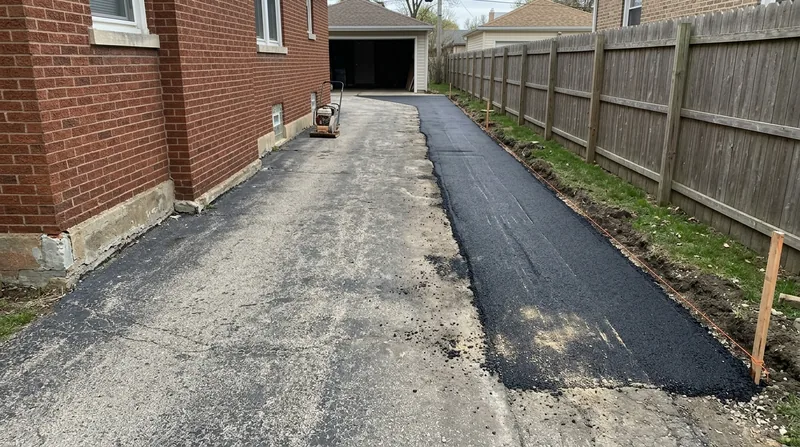




Chicago's tight residential lots demand creative asphalt solutions. The bungalow belt wraps the city in brick homes on narrow grid parcels where a side drive is often a 10-foot ribbon squeezed between neighbors, and a garage apron that's cracked or sunken at the foundation edge is a common repair that turns into a wider conversation about capacity. Farther out, post-war ranches and the big 1990s subdivisions across DuPage, Will, and Kane counties have driveways that are now 20 to 30 years old, and owners frequently ask whether they can add a pad for a third vehicle, widen the existing drive to fit an RV, or rebuild a broken garage apron at the same time. Driveway extensions, widening and aprons in Chicago are small-footprint jobs that demand the same compaction and base preparation as a full driveway, tied seamlessly into existing asphalt with milled joints so the new section bonds rather than sits as a patch. We handle these jobs year-round during the paving season and size them to fit the lot, the local permitting code, and the homeowner's actual need.
Why Driveway Extensions and Widening Matter in Chicago's Tight Lots
Chicago's residential fabric leaves little room for second thoughts. A bungalow side drive built in 1950 was never designed for two cars, and a garage apron poured at the same time is now heaving at the slab edge where the foundation has settled on glacial clay that holds water through the freeze-thaw cycle. When a homeowner decides to add capacity, they face three hard choices: park on the street, pour a parking pad on the lawn, or widen and extend what already exists. The third option makes the most sense, and it requires work that looks simple but is not.
- A parking pad poured adjacent to an existing driveway must tie in with a milled joint so the new asphalt bonds to the old rather than sitting loose and cracking at the seam.
- Widening a drive that was originally 9 feet wide to 12 feet means excavating the soft shoulder, bringing in gravel base, and compacting to match the original drive's density and crown.
- A garage apron that has heaved or cracked often signals a base failure or drainage issue underneath, which must be addressed before the new section is poured or the problem simply moves to the new concrete.
- Municipal permits are required in many Chicago neighborhoods for driveway extensions that increase impervious surface, and some HOAs restrict material or width, so verification with your local building department and HOA rules is essential before we begin.
These jobs are common in Chicago, and they are built the same way a full driveway is, with written specs on compaction, tonnage, and thickness on every estimate.
Local example: A bungalow owner in the Ravenswood neighborhood needed to widen a 9-foot drive to 12 feet to fit a second car. The original drive was 25 years old and the shoulder had settled. We excavated 18 inches, brought in 6 inches of compacted gravel base, and poured 2 inches of hot mix asphalt with a milled joint to tie into the existing drive. The entire job took two days and cost less than a full driveway replacement would have, and the owner kept the original, still-sound asphalt.
For more on how driveway repairs and upgrades fit into your home's long-term asphalt maintenance, see our guide to driveway repair in Chicago.
How We Build Driveway Extensions and Aprons in Chicago
A driveway extension or widening is not a patch. We excavate the area to be added, prepare a compacted base, and tie the new asphalt to the existing drive with a milled joint that ensures the two sections bond rather than crack apart. The work is straightforward, but it demands the same precision as a full driveway install, and it must be done during the paving season when hot mix asphalt is available and the ground is not frozen.
- We measure and locate the area to be extended or widened, then verify that no utilities or buried infrastructure sit in the excavation zone by confirming an Illinois 811 locate before digging begins.
- We excavate to the depth required by the base preparation plan, typically 6 to 8 inches, and remove all soft soil, clay, or failed material.
- We place and compact a gravel base, usually 4 to 6 inches of crushed stone, and proof-roll with a compactor to match the existing drive's density.
- We mill a 1-to-2-inch joint in the edge of the existing asphalt, creating a mechanical bond that prevents cracking and water infiltration at the seam.
- We pour hot mix asphalt into the prepared area, typically 1.5 to 2 inches thick, and compact it with a vibratory roller to match the existing surface.
- The new section is ready for light traffic after 24 to 48 hours, though full cure takes several weeks and the asphalt should not be sealed for at least six to twelve months while it hardens.
This process is the same whether you are adding a parking pad, widening an existing drive, or rebuilding a broken garage apron.
Example from Naperville: A homeowner with an RV needed a 12-by-30-foot pad at the side of the property. The existing driveway was 15 years old and in good condition. We excavated the pad area, brought in 6 inches of compacted gravel, milled a joint into the existing drive edge, and poured 2 inches of asphalt. The new pad ties seamlessly to the old drive, and the homeowner now has room for the RV without damaging the lawn.
For details on how we handle larger driveway projects, including full replacements and resurfacing, see asphalt driveway paving and installation in Chicago.
Methods and Approaches for Driveway Extensions, Widening and Aprons
| Approach | Description | Best for |
|---|---|---|
| Side-drive widening with milled joint | Excavate the shoulder, compact gravel base, mill the existing drive edge, pour hot mix asphalt with seamless tie-in. | Bungalow and ranch homes where a 9-foot drive needs to become 12 feet to fit a second vehicle. |
| Parking pad installation | Excavate a dedicated area adjacent to the driveway, prepare compacted base, mill the existing drive edge, pour asphalt with integrated joint. | Adding a third-car pad or RV space without widening the entire drive. |
| Garage apron repair and extension | Excavate failed or heaved apron, address any underlying drainage or base issues, compact new gravel base, mill the driveway edge, pour new asphalt apron. | Homes where the apron has cracked, heaved, or sunk at the foundation, often due to freeze-thaw or poor drainage. |
| Turnaround or pull-out widening | Extend a driveway apron or turnaround area to improve maneuverability, with milled joints and compacted base throughout. | Narrow lots where a longer or wider turnaround prevents the need to back into the street. |
Driveway Extensions, Widening and Aprons Cost in Chicago: What to Expect
A driveway extension or widening in Chicago typically starts at $1,800 for a small parking pad or a modest widening of an existing drive. The final cost depends on the size of the area being added, the depth of excavation required, whether the existing asphalt needs to be milled, and whether any drainage or base issues must be addressed first. A 12-by-20-foot parking pad runs between $2,500 and $4,000. Widening an existing drive from 9 feet to 12 feet for a 30-foot length runs $2,200 to $3,500. A garage apron repair that involves excavation and base work runs $1,800 to $3,000 depending on the size and whether drainage improvements are needed.
The best way to get an accurate number is to have us measure the area and prepare a written estimate with compacted thickness, tonnage, and base specifications. We include a free estimate within 24 hours of your call, and we typically recommend getting two or three estimates from other paving contractors so you can compare not just price but the detail and transparency of each quote. See our full pricing overview for context on how we structure estimates across all our services.
One note: if your extension or widening is part of a larger driveway repair or resurfacing project, the cost may be lower because we can combine the work. For example, if your entire 30-year-old driveway is showing alligator cracking and you want to add a parking pad at the same time, we may recommend a full asphalt resurfacing or overlay rather than a patch, which can be more cost-effective in the long run.
Driveway Extensions, Widening and Aprons Near Me: What Chicago Homeowners Should Know Before Hiring
Choosing a paving contractor for a driveway extension or widening is straightforward if you know what to look for. You want someone local, fully insured, and willing to give you a written estimate that spells out the compaction standard, the base thickness, and the tonnage of asphalt being used. You also want to verify that your municipality and your HOA, if you have one, have no restrictions on driveway widening or material, and that the contractor understands those local rules before work begins.
- Ask the contractor to show proof of current insurance coverage and provide references from homeowners in Chicago or the surrounding suburbs where similar work was done in the past two years.
- Get at least two written estimates and compare them on specifics, not just total price: what base thickness, what asphalt thickness, what compaction method, and how is the milled joint being handled.
- Verify with your village or city that a permit is required for your driveway extension or widening, and confirm that the contractor will help you navigate the permitting process if one is needed.
- If you live in an HOA community, check your architectural guidelines or CC&Rs to confirm that driveway widening is allowed and that there are no restrictions on material, color, or width.
- Avoid any contractor who shows up unsolicited at your door, demands a large cash deposit, offers a price that seems too good, or refuses to provide a written contract and estimate.
- Ask whether the estimate includes the cost of an Illinois 811 utility locate, which is required by law before any excavation begins and protects you and the contractor.
We are fully insured and have been serving Chicago and the surrounding suburbs since 2011. Call us at (312) 878-9687 for a free, no-obligation estimate, and we will walk you through the permitting process and the local requirements for your specific address.
Driveway Extensions, Widening & Aprons in Chicago: Pricing Guide
| Service | Price | Details |
|---|---|---|
| Small parking pad or apron extension | Starting at $1,800 | Includes excavation, gravel base, milled joint, and 2 inches of hot mix asphalt for areas up to 12-by-15 feet |
| Driveway widening or side-drive extension | Starting at $2,200 | Includes excavation, compacted base, milled joint to existing drive, and hot mix asphalt for 30-foot length and 3-foot width |
| Garage apron repair with base work | Starting at $1,800 | Includes excavation of failed apron, drainage assessment, gravel base, and new asphalt pour with seamless tie-in to existing drive |
| RV pad or large parking extension | Starting at $3,200 | Includes excavation, compacted base preparation, milled joint integration, and 2-inch hot mix asphalt for 12-by-30-foot areas |
| Complex job with drainage or utility concerns | On estimate | Requires on-site inspection to assess base conditions, drainage needs, utility conflicts, and whether milling or excavation depth varies |
| Estimate and site visit | Free | Response within 24 hours at (312) 878-9687, includes measurement, base assessment, and written specification with no obligation to book |
Indicative pricing, the exact cost depends on square footage, finish, and site access. Free personalized estimate within 24h at (312) 878-9687.


