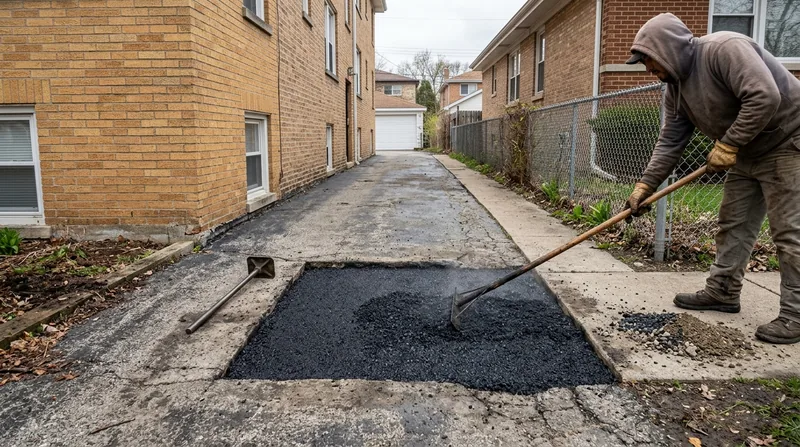




Driveway repair in Chicago means fixing the freeze-thaw damage that hits every March: sunken aprons, crumbling edges, snowplow gouges, and the heaved slabs that open up at the garage threshold after forty winters of ground movement. The glacial clay under Chicago's bungalow belt and first-ring suburbs holds water and swells when frozen, cracking asphalt from below. Across DuPage, Will, Kane, and Lake counties, driveways installed in the 1990s and 2000s are now hitting the 20-to-30-year mark where the base has softened and alligator cracking spreads across whole sections. We repair what can be saved with full-depth patches that key into sound asphalt, not skin patches that peel by spring, and we tell you honestly when the money belongs in resurfacing instead of patching.
Why Driveway Repair Matters in Chicago's Freeze-Thaw Climate
Chicago winters don't just crack asphalt, they destroy it from underneath. Forty freeze-thaw cycles a year push moisture into the base layer, where it expands and contracts, heaving the slab and separating it from the foundation below. Snowplow blades scar the edges every February. A pothole or sunken section isn't cosmetic damage, it's a structural failure that spreads: water gets into the gap, freezes, widens the crack, and by next spring you have twice the problem. Catching it early and patching properly with full-depth material that bonds to the existing asphalt can buy you five to ten more years. Waiting until the cracks have multiplied across thirty or forty percent of the surface means the base is gone and you're into resurfacing or replacement territory.
- Freeze-thaw heaving opens gaps between the slab and the base, trapping water that expands and worsens the damage each winter.
- Snowplow blades gouge edges and corners, leaving seams where moisture enters and spreads the failure sideways.
- Full-depth patches remove failed material down to the base, compact new asphalt tight, and bond it to sound surrounding asphalt so water cannot seep underneath.
- Early repair prevents the job from becoming a full resurfacing, which costs two to three times as much.
The window to patch is spring through fall, when the asphalt is warm enough to compact properly and bond to the existing surface.
Key info: In Chicago, Cicero, and Schaumburg, many residential driveways on narrow side lots or rear alleys drain poorly and hold standing water, making them prime targets for pothole formation by April. A driveway with a low spot or poor drainage slope will fail faster than one on higher ground, even if both were poured the same year.
For more on the scope of pothole and patching work, see our pothole repair and asphalt patching page.
How We Repair Driveways: Site Assessment to Finished Surface
We start every driveway repair with a walk-through to measure the failed area, check the condition of the surrounding asphalt, and decide whether patching or resurfacing makes sense. If the damage is isolated to a few spots and the rest of the driveway is sound, full-depth patching is the right answer. If the whole surface is crazing, crumbling, or sinking in multiple places, we'll recommend resurfacing or an overlay. We write every estimate with compacted thickness and tonnage specs so you know exactly what you're paying for.
- We measure the failed area and take cores or probe the existing base to check its condition and depth.
- We saw-cut the perimeter of the patch in straight lines so the new asphalt has a clean edge to bond to.
- We remove all broken asphalt and loose base material, then compact the remaining base with a plate compactor.
- We set the patch depth to match the surrounding asphalt, apply a tack coat to the cut edges, and place hot mix asphalt in lifts, compacting each layer.
- We finish-roll the patch flush with the surrounding surface so water drains properly and the seam is stable.
The whole job typically takes one day for a standard driveway with one to three patches, depending on the size and access.
Example: A Naperville bungalow with a sunken apron and two potholes in the main drive had about 80 square feet of failed asphalt. We removed the bad material, compacted the base, and set two 4-inch lifts of hot mix, finishing with a 1.5-inch wearing course. The job took five hours, cost $680, and the patches are now five years in with no edge failures or water intrusion.
If your driveway needs more than patching, explore our asphalt resurfacing and overlay options.
Driveway Repair Methods: Full-Depth Patching vs. Skin Patches
| Approach | Description | Best For |
|---|---|---|
| Full-Depth Patch | Remove all failed asphalt and base, saw-cut straight edges, compact new base, place hot mix in lifts, finish flush with surrounding surface. | Potholes, sunken sections, edge failures, isolated damage on otherwise sound driveways. |
| Skin Patch (Cold or Hot Overlay) | Place asphalt or cold-patch material on top of existing damaged surface without removing the failed base. | Temporary fixes only; water enters underneath and the patch peels within one to two seasons. |
| Asphalt Resurfacing (Overlay) | Mill or grind the top 1 to 2 inches of the old asphalt, compact the base, and place a new wearing course over the entire driveway. | Driveways with widespread crazing, alligator cracking, or multiple patches where the base is still sound. |
| Full Replacement | Mill away all existing asphalt, remove and replace the base if necessary, and install new asphalt to design thickness. | Driveways with failed base, extensive heaving, or where the original grade is too low and causes pooling. |
Full-depth patching is the honest choice for damage that is truly isolated. If cracks are spreading across the whole surface, patching is throwing money away, and you should invest in resurfacing instead.
Driveway Repair Cost in Chicago: What to Expect
Driveway repair pricing in Chicago starts at around $450 for a small single patch and scales with the size of the failed area, the depth of the base, and the complexity of access. A typical residential driveway with one to three potholes or a sunken apron runs $600 to $1,200. Larger jobs with multiple failed sections, poor base conditions, or tight access can reach $1,500 to $2,500. The biggest cost driver is the amount of base preparation needed: if the base is intact and compacted, the job is faster and cheaper. If the base is soft or has settled, we have to remove more material and recompact, which adds time and tonnage.
We always measure the site and provide a written estimate with compacted thickness and tonnage before we start. That way you know the scope and the cost up front, with no surprises. Most homeowners find that getting two or three estimates helps them understand the range and the reasoning behind different contractors' approaches. Some will offer a cheap skin patch that fails by summer; we spec full-depth work that holds.
For a detailed pricing overview across all our services, visit our full pricing page.
Driveway Repair Near Me: What Chicago Homeowners Should Know Before Hiring
Driveway paving and repair is not licensed at the state level in Illinois, but many Chicago-area municipalities do license or register paving contractors by name. Before you hire any contractor, ask them for the license or registration their village requires and verify it with your local building department or village hall. The City of Chicago requires a General Contractor license for work that involves a building permit. In suburbs like Northbrook, Aurora, and Schaumburg, the village issues its own paving contractor license or registration. Confirm what your municipality requires and ask your contractor to show you proof.
- Verify that any contractor is fully insured and ask for a certificate of insurance naming your address as an additional insured.
- Get written estimates from at least two contractors, with thickness, tonnage, and method clearly stated so you can compare apples to apples.
- Check references from recent work in your area, and ask those homeowners whether the patches or resurfacing have held up.
- If your driveway extends into the right-of-way or involves a curb cut, ask your village whether a permit is required before work begins.
- If you live in an HOA community, check your architectural guidelines before approving any repair, as some HOAs restrict materials or require approval for driveway work.
- Avoid contractors who show up unsolicited at your door, offer a price on the spot without measuring, ask for a large cash deposit, or claim they have leftover asphalt from a nearby job.
We're a local Chicago shop with local plates and a local address. We've been in business since 2011, and we stand behind every estimate and every job. For a free, no-obligation estimate with compacted thickness and tonnage specs, contact us or call (312) 878-9687.
Driveway Repair in Chicago: Pricing Guide
| Service | Price | Details |
|---|---|---|
| Single pothole or small patch | Starting at $450 | Full-depth removal and replacement of one isolated failure up to 20 square feet with intact base. |
| Multiple patches or sunken apron | Starting at $750 | Two to four patches or a sunken driveway apron with proper base preparation and compaction in lifts. |
| Large repair or complex access | Starting at $1,200 | Extensive patching, poor base conditions, or difficult site access requiring additional equipment or crew time. |
| When patching isn't enough | On estimate | Widespread alligator cracking or base failure means resurfacing or full replacement; site visit required for accurate quote. |
| Estimate and site visit | Free | Response within 24 hours, written estimate with thickness and tonnage specs, no obligation to book. |
Indicative pricing, the exact cost depends on square footage, finish, and site access. Free personalized estimate within 24h at (312) 878-9687.


