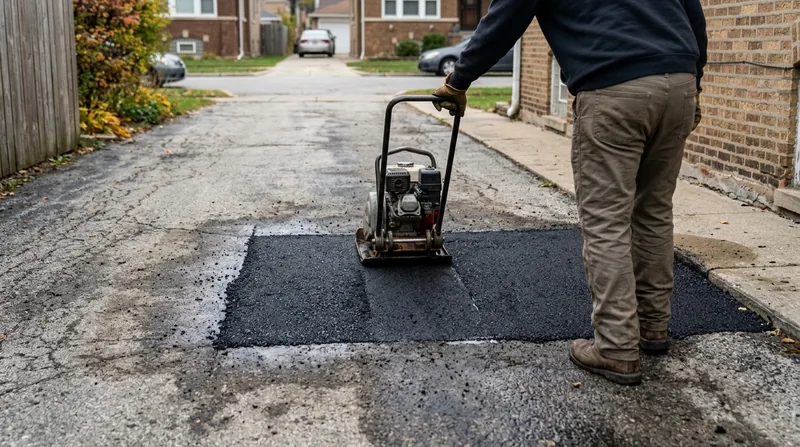




Chicago's glacial clay and forty-odd freeze-thaw cycles a winter are the perfect recipe for potholes. Every spring, the thaw opens cracks in driveways across the city, from the narrow side drives of the bungalow belt to the long aprons of suburban ranches to the parking lots and private roads of the exurbs. Pothole repair and asphalt patching are not cosmetic fixes here; they are the difference between a driveway that holds another decade and one that fails section by section. We cut potholes square, tack-coat them, and fill them with compacted hot mix, or use infrared patching to recycle the surface in place for seamless, wait-free repairs. Spring booking fills fast, because one hole left alone becomes a failed section, and failed sections cost far more to fix. Get a fast assessment early.
Why Pothole Repair & Asphalt Patching Matters in Chicago's Climate
Potholes are not random. They form when water seeps under the asphalt, freezes, expands, and heaves the surface. The thaw leaves a void underneath, and traffic pounds the weakened top layer into rubble. Chicago gets roughly forty freeze-thaw cycles per winter, and the heavy glacial clay that underlies most of the city holds water like a sponge. Snowplow blades scar the edges every February. The result is predictable: every spring, potholes erupt in clusters. The driveway that was fine in January can have five potholes by April if the base has started to fail.
- Water infiltration under the asphalt weakens the base layer and creates voids that collapse under traffic.
- Freeze-thaw cycles in Chicago's climate accelerate pothole formation far faster than in regions with milder winters.
- Potholes left unrepaired spread rapidly; one hole can become five within weeks as the surrounding asphalt breaks apart.
- Patching early in the season prevents cascading failure and saves thousands in resurfacing or replacement later.
- Heavy vehicles, delivery trucks, and snowplows worsen potholes by punching through weakened edges and expanding the damage zone.
Addressing potholes in spring, before the heat of summer and the heavy rains of autumn, is the most cost-effective maintenance decision a homeowner or property manager can make in this region.
Key info: Chicago's building department and most suburban villages require permits for driveway work that involves excavation or changes to drainage. Verify with your local municipality or HOA before work begins. Illinois law requires a utility locate (call 811) before any digging, even for pothole patching that goes to the base.
For more information on the full scope of repair and maintenance options, see our guide to driveway repair in Chicago.
How Pothole Repair & Asphalt Patching Works in Chicago
We assess the damage on site, measure the affected area, and determine whether the pothole is isolated or part of a larger failure pattern. If it is isolated and the surrounding asphalt is sound, we patch. If the base is compromised or alligator cracking covers more than thirty to forty percent of the surface, we recommend resurfacing or replacement instead, because patching throws money away on a surface that will fail again within a year or two. We do not patch our way into a second job; we patch when it makes sense and advise resurfacing or replacement when it does not.
- We square-cut the pothole to create clean, stable edges that lock the patch in place.
- We clean out all loose debris, water, and weakened base material to bare, compacted ground.
- We apply tack coat (a sticky bonding agent) to the cut edges so the new asphalt adheres to the old.
- We fill the hole with compacted hot mix asphalt, tamped in lifts to match the surrounding surface elevation and density.
- Infrared patching is available for seamless repairs that recycle the surface in place without cold joints or wait time before driving.
- We provide written estimates with compacted thickness and tonnage specifications on every job, so you know exactly what you are getting.
The entire process takes hours for most residential potholes, and the driveway is usable the same day once the patch cools. Infrared patches can be driven on within thirty minutes.
Example: A two-car driveway in Naperville with three small potholes clustered near the apron typically takes three to four hours to assess, cut, and patch. A larger pothole in a Cicero alley drive that has reached the base may require a full-depth patch or recommend a full resurfacing of the affected section. We measure and estimate on site, never over the phone.
For complex repairs or if you are unsure whether your driveway needs patching or full resurfacing, we offer a free assessment and written estimate.
Pothole Repair & Asphalt Patching Methods: Which Approach Is Right for You?
| Method | Description | Best for |
|---|---|---|
| Square-Cut Cold Patch | We cut the pothole square, clean it out, apply tack coat, and fill with compacted hot mix. The edges are sealed and locked. This is the standard, proven method used across the industry. | Isolated potholes in sound asphalt, budget-conscious repairs, driveways that are otherwise in good condition. |
| Infrared Asphalt Patching | We heat the surrounding asphalt to working temperature, recycle it into the patch zone, and blend it seamlessly with the existing surface. No cold joints, no wait time, drive on it immediately. | Potholes where appearance and immediate use matter, parking lots, high-traffic areas, seamless repairs that look and perform as one surface. |
| Full-Depth Patch | We excavate the pothole to the base, remove all failed material, compact a new base layer, and install fresh asphalt to full depth (typically 2 to 3 inches). This addresses damage that has reached the foundation. | Potholes that have compromised the base, large holes, areas where multiple potholes cluster, driveways with base failure or heave. |
| Patch and Monitor | We patch the immediate pothole, but we also assess whether the surrounding asphalt shows signs of widespread base failure (alligator cracking, soft spots, multiple holes in close proximity). If resurfacing is needed, we tell you now, not after the patch fails. | Homeowners who want to know if they should budget for resurfacing, property managers planning capital maintenance, early-stage failure assessment. |
Not every pothole needs the same repair. We assess the damage on site and recommend the method that actually solves the problem, not the one that generates the biggest invoice.
Pothole Repair & Asphalt Patching Cost in Chicago: What to Expect
Pothole repair pricing depends on the size of the hole, the depth of the damage, whether the base is sound or compromised, access for equipment, and the method you choose. A small isolated pothole in a residential driveway typically starts at around $450 to $600, including assessment, cutting, cleaning, tack coat, and compacted hot mix fill. Larger potholes, full-depth patches, or infrared repairs cost more. If multiple potholes cluster or if the base is extensively failed, resurfacing the affected section often costs less per square foot than patching multiple holes.
- Size matters: a pothole the size of a dinner plate costs far less than one the size of a car tire or larger.
- Depth and base condition determine method: a surface patch is cheaper than a full-depth repair that addresses base failure.
- Multiple potholes in one driveway may qualify for a volume discount or a resurfacing estimate instead of individual patches.
- Infrared patching costs more per hole than cold patch, but it eliminates wait time and cold joints, and it is often worth the premium for visible areas or high-traffic zones.
- Access and equipment: tight alley drives or driveways with limited turnaround space may require hand work or smaller equipment, which can increase labor cost.
- We provide written estimates with thickness and tonnage specifications on every job, so there are no surprises at invoice time.
The best way to know what your specific potholes will cost is to get an on-site assessment. We offer free estimates and respond within 24 hours at (312) 878-9687. See our full pricing overview for more detail on what drives cost in different scenarios.
Real example: A homeowner in Evanston called about a single large pothole near the garage apron. The hole was roughly 18 inches across and had reached the base. A full-depth patch ran $850 including base prep and compaction. The same homeowner, if he had called six months later when the damage had spread to five holes across the drive, would have been looking at a $3,500 to $4,500 resurfacing estimate instead. Early patching saved him thousands.
Pothole Repair & Asphalt Patching Near Me: What Chicago Homeowners Should Know Before Hiring
Choosing a paving contractor is a straightforward decision if you know what to look for. Ask any contractor for proof of insurance (we are fully insured and provide a certificate on request). Check whether your municipality or HOA requires a contractor license or registration for paving work; Illinois licenses contractors at the municipal level, not the state level, so requirements vary from village to village. Chicago requires a General Contractor license for work that involves a building permit. Call your local building department and ask what your contractor should have. Get multiple estimates (at least two or three) so you can compare method, price, and what is actually included. Ask about references and look at past work if possible. Understand what you are getting: is it a cold patch, a hot patch, an infrared repair, or a full-depth replacement? How thick will the patch be, and what tonnage of material goes in? A contractor who can answer these questions with specifics is one who knows the trade.
- Verify insurance: ask for a current certificate of insurance that names your property as an additional insured.
- Check local licensing requirements with your city or village building department before you hire.
- Avoid any contractor who shows up unsolicited, offers work from "leftover material from a job nearby," demands a large cash deposit, or gives a price over the phone without seeing the damage.
- Get written estimates that specify thickness, tonnage, method, and timeline, not just a total price.
- Ask about warranty: honest paving contractors offer a one- to three-year workmanship warranty, not a lifetime warranty (asphalt is a material, not a manufactured product, and carries no manufacturer warranty).
- If your driveway is in an HOA, check the architectural guidelines before work begins; some communities restrict paving contractors or require pre-approval.
- Ask whether the contractor will pull any required permits or help you navigate the permitting process; permitting requirements vary by municipality.
We are fully insured, we hold written estimates with full specifications on every job, and we can walk you through any local permitting requirements for your specific address. Call us at (312) 878-9687 for a free estimate, or visit our contact page to request an assessment.
Pothole Repair & Asphalt Patching in Chicago: Pricing Guide
| Service | Price | Details |
|---|---|---|
| Single small pothole | Starting at $450 | Cold patch, square-cut, tack-coated, compacted fill; isolated holes in sound asphalt, typical residential driveway |
| Medium pothole or full-depth patch | Starting at $750 | Hole reaching the base layer, base prep, new compacted asphalt, or infrared repair for seamless blending |
| Multiple potholes or cluster repair | Starting at $1,200 | Three or more potholes in one drive; may recommend resurfacing if damage is extensive or base is widely compromised |
| Infrared seamless patching | Starting at $900 | Recycled surface patch with no cold joints, immediate drivability, premium finish for visible or high-traffic areas |
| Free estimate | No charge | On-site assessment with written thickness and tonnage specifications, response within 24 hours at (312) 878-9687 |
Indicative pricing, the exact cost depends on square footage, finish, and site access. Free personalized estimate within 24h at (312) 878-9687.


