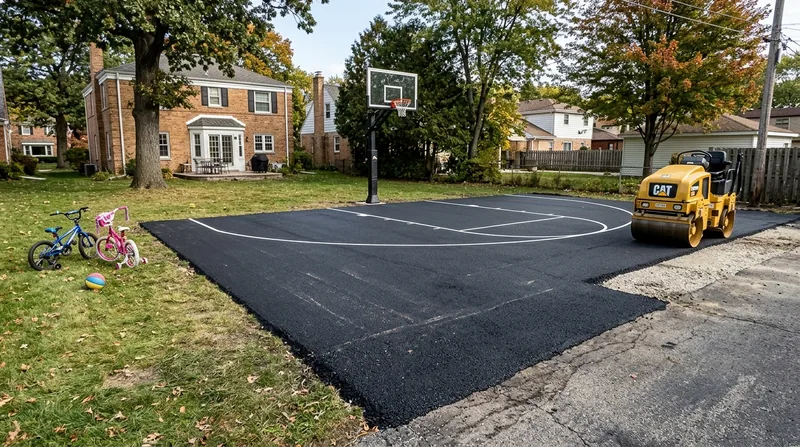




Sports Court & Path Paving in Chicago means building a dead-flat, durable asphalt base that holds its line through forty freeze-thaw cycles a winter and keeps your basketball court, tennis court, pickleball pad or walking path true for years. Chicago's glacial clay soil heaves under winter pressure, and standard paving without proper base prep and tight tolerance will fail fast. We build the structure that resists that movement, then finish it smooth and level so your acrylic color system stays flat and your court plays fair.
Residential properties across Chicago, from the tight side drives of the bungalow belt to the open lots of the collar counties, are adding recreation surfaces that demand precision. Tennis and pickleball courts need dead-flat bases with minimal deviation. Basketball courts require consistent slope for drainage but zero waviness underfoot. Walking paths and golf cart trails on acreage in Barrington, Homer Glen, and the Kendall exurbs need to shed water without ponding. That means the asphalt itself has to be engineered, not just poured.
We handle the full build: base preparation, proof rolling, proper compaction, and a finish course laid to tight tolerance. Your court stays true because we build it right the first time.
Why Sports Court and Path Paving Matters in Chicago's Residential Market
Chicago's climate and soil present specific challenges for recreational surfaces. Winter freeze-thaw cycles heave and crack pavement that was not built with a solid, well-drained base. The heavy glacial clay that covers the region holds moisture and expands when it freezes, lifting asphalt slabs and opening cracks. A tennis court or basketball court built on a weak or improperly compacted base will develop low spots, ripples, and alligator cracking within two to three years, making play unsafe and requiring expensive repair or replacement.
- A dead-flat court surface is essential for fair play and player safety on basketball and tennis courts.
- Proper base preparation and compaction prevent frost heave and soil movement that cracks recreational asphalt.
- Tight tolerance finishing ensures your acrylic color coating adheres evenly and lasts without premature wear.
- Correct drainage slope sheds water without creating puddles or low spots that accelerate deterioration.
- Chicago's forty-plus annual freeze-thaw cycles demand a structure built to withstand that specific climate stress.
A court built to spec will serve for fifteen to twenty years with normal maintenance. One built cheap or fast will fail in five.
Chicago example: A residential tennis court in Evanston or Downers Grove sits on clay that moves every winter. If the base is not compacted in lifts and the asphalt is not finished to tight tolerance, frost heave will crack the surface by year two. We build to prevent that from the ground up.
For more on how proper base preparation protects all asphalt surfaces, see our page on Sports Court & Path Paving in Chicago.
How We Build Sports Courts and Paths: The Process in Chicago
Building a court or path that stays true requires precision at every step. We start with a site survey and soil assessment, then prepare and compact the base in controlled lifts. We proof roll to verify compaction, add a binder course, then finish with a smooth top course laid to tolerance. The whole process takes planning and attention to detail, not speed.
- We measure the site, confirm slope and drainage requirements, and assess soil conditions.
- We excavate or grade to the correct elevation and remove unstable material.
- We place and compact the base course in lifts, testing compaction as we go.
- We proof roll the base to verify it will not move under load.
- We lay the binder course and finish with a tight-tolerance surface course.
- We provide written specifications showing compacted thickness and tonnage on every job.
This is not a one-day pour. A full court build typically takes three to five days depending on size and weather, with curing time before you can apply color coating.
Schaumburg example: A backyard basketball court on a half-acre lot required base prep on clay that held spring moisture. We cut the site, brought in stone base, compacted in four-inch lifts with proof rolling between each, then finished with two inches of asphalt to tolerance. The court is now five years old and remains flat and playable.
Learn more about how we prepare sites and manage drainage in our guide to Gravel Driveway Installation and Grading, which uses the same base-prep principles.
Sports Court and Path Paving Methods and Approaches
| Approach | Description | Best for |
|---|---|---|
| Full-depth new court | Complete site preparation, base compaction, binder and finish courses, finished to tight tolerance. | New courts, poorly drained sites, or where existing surface is unsuitable. |
| Overlay on stable base | Milling existing surface, verifying base integrity, then laying new finish course to tolerance. | Existing courts with sound base but worn or cracked surface. |
| Walking paths and trails | Graded base with compacted stone, three to four inches of asphalt, finished for drainage and safety. | Residential paths, golf cart trails, and pedestrian routes on acreage. |
| Tolerance finishing | Final course laid to plus-or-minus one-quarter inch over thirty feet, essential for court play. | All recreational surfaces where surface flatness affects play or safety. |
Sports Court and Path Paving Cost in Chicago: What to Expect
A full-depth basketball or tennis court in Chicago starts at around $8,500 for a small residential court on a prepared site with good drainage. The price moves up with court size, site complexity, soil conditions, and base preparation work. A half-court is less; a full court on clay requiring extensive base work is more. Walking paths run lower per square foot because they do not demand tight tolerance. Every job is quoted on site after measurement and soil assessment.
Factors that affect cost include court dimensions, existing site conditions, drainage requirements, soil stability, access for equipment, and whether the base requires full excavation or can be built on existing grades. A site with poor drainage or unstable clay will cost more to prepare than one with good grades and existing stone. Get two or three estimates so you can compare approach and understand why prices differ.
Cost example: A thirty-by-sixty-foot residential basketball court with full base prep on clay soil in Arlington Heights or Cicero typically runs $12,000 to $16,000 depending on site grading and drainage needs. A pickleball court at twenty by forty feet starts around $6,500 to $9,000. A quarter-mile walking path on acreage runs $4,500 to $7,000.
For a detailed breakdown of pricing across all our services, visit our full pricing overview. Call us at (312) 878-9687 for a free, no-obligation estimate on your court or path project.
Sports Court and Path Paving Near Me: What Chicago Homeowners Should Know Before Hiring
When you hire a paving contractor for a recreational court or path, you are making an investment in a surface that will be used for years. The contractor's experience, attention to detail, and honest guidance matter more than price alone. Ask any contractor for proof of insurance and verify that they carry general liability coverage. Ask about their approach to base preparation and compaction, and request a written estimate that includes thickness, tonnage, and compaction specs.
Check references from recent court or path projects. Ask whether the contractor has experience with Chicago's clay soil and freeze-thaw climate. If your property is in an HOA or master-planned community, confirm with the HOA that the court design meets architectural standards before work begins. If the project involves a curb cut, driveway apron, or utility work, your municipality may require a permit. The contractor should help you understand what permits apply in your city or village.
Avoid contractors who offer a price without visiting the site, who pressure you to sign quickly, or who demand a large cash deposit upfront. Get multiple estimates so you can compare. The lowest bid is often a sign that corners will be cut. The honest contractor will explain why base prep costs what it does and will not promise a lifetime warranty on asphalt, because asphalt is a material that ages and requires maintenance.
For more information or to request a free estimate, contact us here or call (312) 878-9687. We serve Chicago and the surrounding areas, and we are fully insured.
Sports Court & Path Paving in Chicago: Pricing Guide
| Service | Price | Details |
|---|---|---|
| Small residential court (half-court or pickleball) | Starting at $6,500 | Twenty by forty feet or smaller, including full base prep, compaction, and finish course to tolerance |
| Full basketball or tennis court | Starting at $8,500 | Thirty by sixty feet, standard site conditions, proper base preparation and tight-tolerance finish included |
| Walking path or golf cart trail (per 500 linear feet) | Starting at $4,500 | Eight to ten feet wide, graded base, compacted stone, three to four inches of asphalt with drainage slope |
| Complex site or large court with extensive base work | On estimate | Poor drainage, clay requiring deep excavation, or court larger than sixty by ninety feet requires on-site assessment |
| Estimate | Free | Site visit, measurement, and written estimate with specs within twenty-four hours, no obligation to book |
Indicative pricing, the exact cost depends on square footage, finish, and site access. Free personalized estimate within 24h at (312) 878-9687.


