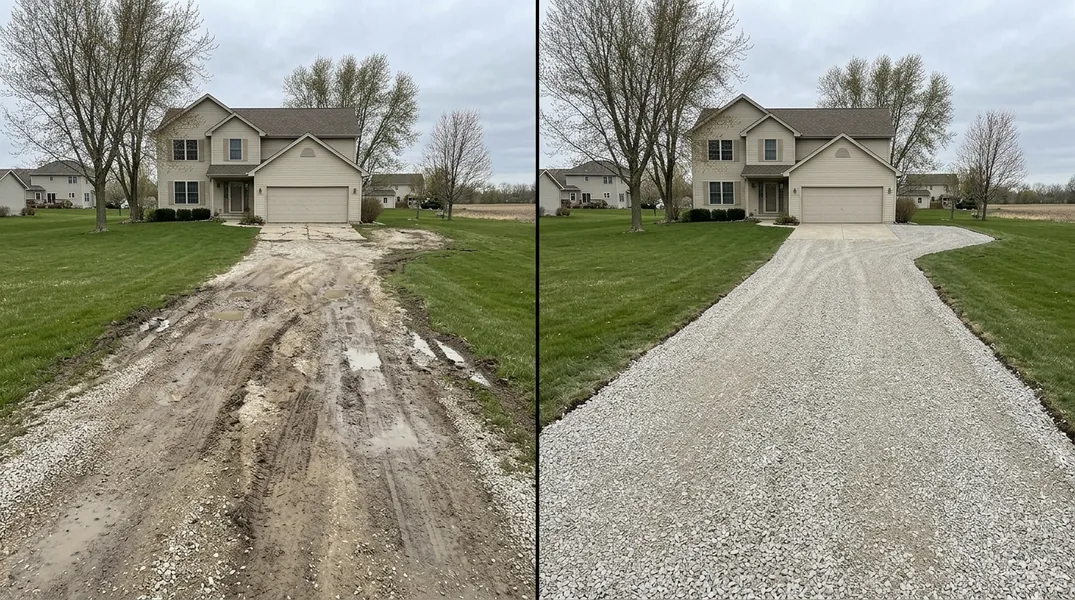
Why Chicago Clay Causes Driveway Drainage Problems
If you own a driveway in Chicago, you've likely noticed water pooling on your asphalt after heavy rain. This isn't just an eyesore or a temporary inconvenience. Standing water on your driveway is one of the fastest ways to damage asphalt, leading to cracks, potholes, and premature deterioration that can cost thousands to repair.
The culprit behind most Chicago driveway drainage issues is the region's dense clay soil. Clay has poor drainage characteristics because its particles are extremely fine and compact tightly together, preventing water from percolating downward. Instead of soaking into the ground, water sits on top of your driveway, creating pools that weaken the asphalt base layer and accelerate surface deterioration. This is especially problematic in the Chicago area, where spring snowmelt and summer thunderstorms can dump significant amounts of water in short periods.
Understanding Water Pooling on Driveway: The Root Causes
Water pooling on driveway surfaces happens for several interconnected reasons, and understanding them is the first step toward finding a real solution. The most obvious cause is improper slope or grade. Your driveway should slope slightly away from your home and toward the street or a designated drainage area. If your driveway is flat or slopes the wrong direction, water will naturally collect in low spots rather than flow away. Over time, settling and shifting of the asphalt base can change the slope, creating new pooling areas where none existed before.
Another major factor is the condition of your driveway's subsurface. When Asphalt Driveway Paving & Installation is done properly, contractors install a gravel or crushed stone base layer beneath the asphalt. This base layer is designed to allow water to drain downward and away. However, if the base layer becomes compacted, contaminated with clay sediment, or wasn't properly constructed in the first place, water cannot drain effectively. Additionally, cracks and deteriorating asphalt allow water to penetrate the surface and become trapped in the base layer, where it weakens the structural integrity of your entire driveway.
Driveway French Drain Solutions: A Proven Method
One of the most effective driveway drainage solutions for Chicago properties is installing a driveway French drain system. A French drain is a underground drainage system that consists of a perforated pipe surrounded by gravel, designed to collect and redirect water away from your driveway. Unlike surface-level solutions, French drains work below ground level, intercepting water before it can pool on your asphalt surface.
Here's how a French drain works: The perforated pipe is installed in a trench alongside or beneath your driveway, typically at a slight downward angle. As water seeps into the ground around your driveway, it enters the perforations in the pipe and flows through the system toward a designated outlet, such as a storm drain, dry well, or lower-lying area of your property. The gravel surrounding the pipe acts as a filter, preventing soil particles from clogging the perforations while allowing water to flow freely. For homeowners in Chicago dealing with persistent water pooling, a French drain can be transformative, especially when combined with proper asphalt grading and base layer preparation.
The effectiveness of a French drain depends on proper installation depth, slope, and outlet location. A shallow drain installed incorrectly won't solve the problem, and an outlet that's too high won't allow water to flow naturally. This is why working with experienced professionals matters. Chicago Asphalt Paving has installed countless French drain systems throughout the region, ensuring they're designed and positioned to handle the specific drainage challenges of Chicago clay soil.
Trench Drain Driveway Systems: When You Need Heavy-Duty Drainage
For properties with more severe drainage challenges or high-volume water runoff, a trench drain driveway system offers a more robust solution than a traditional French drain. Also called a linear drain or channel drain, a trench drain consists of a long, narrow channel installed across your driveway surface that collects water and directs it away through an underground pipe system. Unlike French drains that work entirely underground, trench drains include a visible grate or channel opening on the driveway surface, making them ideal for areas where water regularly accumulates.
Trench drain systems are particularly valuable for Chicago properties with significant elevation changes, properties near natural water collection areas, or driveways that experience heavy rainfall runoff from roofs and surrounding terrain. The channel can be installed perpendicular to the direction of water flow, creating a barrier that captures water before it pools. The collected water then flows through an underground pipe to a suitable outlet. Modern trench drains are designed to be durable and can be installed to match your driveway's aesthetic, with options for different grate materials and finishes.
Installing a trench drain requires careful planning to ensure the channel slope is correct and the outlet is positioned properly. The installation must also be coordinated with your driveway's overall grading plan. If you're considering a trench drain system, a professional site assessment is essential to determine the best placement and design for your specific property conditions.
Additional Driveway Drainage Solutions: Grading, Repair, and Resurfacing
While French drains and trench drains address subsurface water issues, several complementary solutions can improve overall drainage. Proper driveway grading is foundational. If your driveway doesn't slope adequately away from your home and toward the street, water will always find low spots where it collects. Correcting the grade might involve Asphalt Resurfacing & Overlay work, which removes and replaces the top layer of asphalt to create the correct slope. This approach is more cost-effective than complete removal and replacement when the base layer is still sound.
Existing cracks and damage should also be addressed promptly. Water enters through cracks and becomes trapped in the base layer, where it weakens the foundation of your driveway and accelerates deterioration. Driveway Repair services, including crack sealing and Pothole Repair & Asphalt Patching, should be performed before installing a new drainage system. Addressing these issues first ensures your drainage solution works effectively and your driveway has a solid foundation.
In some cases, improving drainage also means improving the base layer itself. If the existing base is compacted clay or has deteriorated, replacing it with a proper gravel or stone base will dramatically improve water permeability. This is especially important in Chicago, where clay soil naturally resists drainage.
Getting Professional Help: Driveway Drainage Solutions Near Me
Diagnosing and fixing driveway drainage issues requires expertise and experience. What looks like a simple water pooling problem might actually involve multiple factors: incorrect slope, poor base layer condition, inadequate outlet positioning, or a combination of all three. A professional assessment can identify the root causes specific to your property and recommend the most effective and cost-efficient solution.
Chicago Asphalt Paving specializes in comprehensive drainage solutions tailored to the unique challenges of the Chicago area. Our team understands how clay soil behaves, how to design systems that actually work in our climate, and how to integrate drainage improvements with driveway repairs and resurfacing. Whether you need a French drain, trench drain, grading correction, or a combination approach, we can help. Call us at (312) 878-9687 or request a free estimate to discuss your drainage concerns. We'll evaluate your driveway, explain your options, and provide a clear plan to eliminate water pooling for good.
Looking for a professional asphalt paving contractor in Chicago? Chicago Asphalt Paving responds fast for all your asphalt paving needs.
Get a Free Quote